


How Galway Made Clothes Repair Part of a Weekend Out

From a repair table in a charity shop to a fashion show in a church, ReStyle Galway explored how clothes already in our wardrobes could get another outing.
Most wardrobes have a few things we mean to sort out. A shirt is missing a button. A favourite pair of jeans has worn thin at the knee. A coat we once loved never seems to fit quite right any more. These are small problems, but they can leave clothes unworn for months. What if you could take those jeans to a repair table while you were at the market, or bring the coat to a clothes swap on the same trip?
On 7 and 8 November 2026, ReStyle Galway brought those possibilities together in the west of Ireland. The daytime programme included clothes and shoe repairs, a clothes swap and a vintage market. For Sunday evening’s fashion show at St Nicholas’ Collegiate Church, organisers invited guests to wear something borrowed, a favourite vintage piece or an outfit they had reworked themselves.
A repair table at the Saturday market
ReStyle Galway was organised by The Environmental Forum in partnership with local vintage studio LIVVS and featured in the Irish Design Week programme. The Design & Crafts Council Ireland listed four main venues. COPE Galway’s charity shop and LIVVS Vintage Studio were listed for daytime activities including alterations, repair demonstrations, clothes swapping and workshops. H91 Markets at Electric Galway paired its vintage market with a drop-in repair café, while St Nicholas’ Collegiate Church was the venue for the Sunday show. Saturday’s public programme ran from 11 am to 5 pm. The organisers listed free clothes and shoe repairs among the activities, with some places allocated on a first-come, first-served basis.
Putting a repair table inside a market makes it easier to ask a small question before it becomes another job to put off. Has the stitching come undone, or has the fabric itself worn through? Could the trousers be patched at home, or would they benefit from an alterations service? A drop-in session gives someone a chance to bring the garment in and find out.
The Saturday timetable listed a session on needle felting and visible mending with Margaret Nolan at 11.30 am, alongside Tyler Holt’s crochet workshop. At noon, Brigid Gallagher’s weaving session was due to cover everything from setting up a loom to making a piece of cloth.
Visible mending leaves the repair on show. On a pair of jeans, a darker patch can make a subtle change, while a contrasting thread makes the stitching part of the look. Choosing the cloth, the colour and the shape of the patch gives the wearer a say in how the garment looks after repair.

Jeans visibly mended with mint-green embroidery thread. Photograph by Lisenka92, via Wikimedia Commons. Image source · CC BY-SA 4.0
What do you wear to a show about clothes you already own?
The Sunday evening show, Heritage by Design, was scheduled for 8 November at St Nicholas’ Collegiate Church. The published programme included a conversation about Irish fashion heritage, alongside vintage clothing, reworked garments, millinery and accessories. The dress code was black tie, with room for interpretation. A borrowed jacket, a vintage dress or something altered at home could all fit the occasion. For anyone with a formal outfit worn just once, the invitation offered a reason to take it out of the wardrobe again.
The weekend programme also introduced Relove Fashion, a design competition run by the Rediscovery Centre. It is open to young people aged 12 to 19 in second-level education in participating areas. Entrants can work alone or in teams of up to five, using second-hand or unwanted textiles to make a wearable outfit and recording how they developed it. Previous entrants have used old bridesmaid dresses and even discarded trampoline netting.
It is a brief that could work in a design classroom. Take an old shirt apart and there may be very little uninterrupted cloth, but the pocket, cuffs and button placket are already made. With a worn pair of jeans, the knees may be too weak to use while the backs of the legs are still sound. Examining what can be kept gives students a concrete starting point for deciding what to make.
How second-hand clothes change hands in Ireland

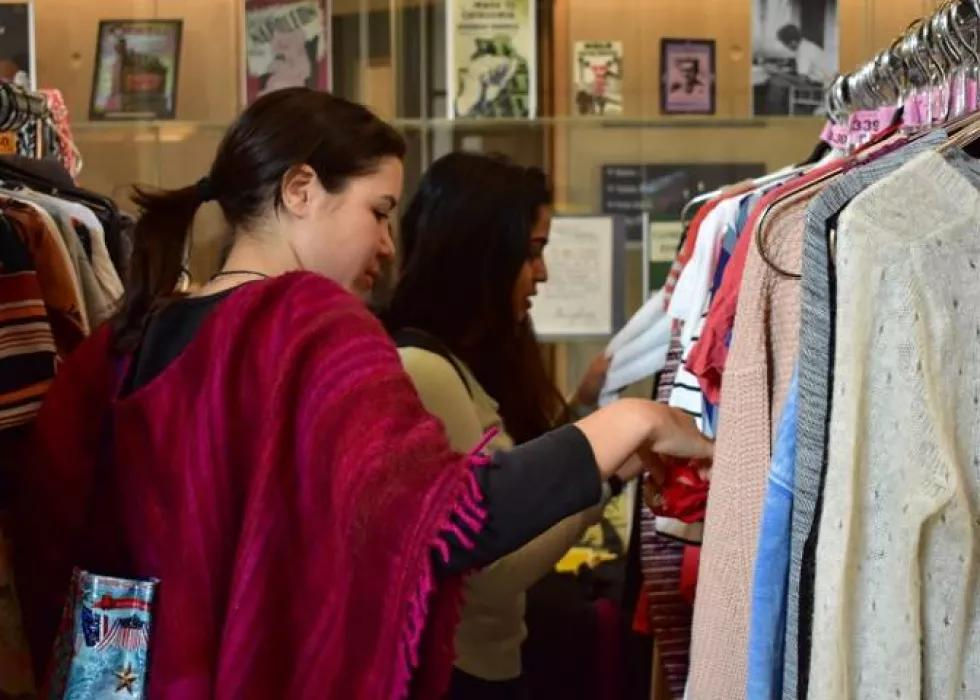
Clothes racks at a clothing swap in Ottawa, Canada, 2010. Photograph by Samantha Dye, via Wikimedia Commons. Image source · CC BY-SA 2.0
Ireland’s Environmental Protection Agency (EPA) estimates that households reused approximately 4,660 tonnes of textiles in 2024 through the routes covered by its survey. The estimate comes from the number of second-hand items respondents said they had bought or received, converted into weight. The figures below cover clothing within that wider textiles category.
How Irish households obtained second-hand clothing in 2024 | Estimated weight |
Private gifts, donations or swaps | 1,764 tonnes |
Purchases from second-hand shops or marketplaces | 1,479 tonnes |
Purchases through online platforms | 894 tonnes |
The EPA groups private gifts, donations and swaps together, so the share attributable to clothes swaps cannot be calculated separately. These national figures show some of the routes by which clothes find another wearer. The available public material for ReStyle Galway does not give a count of garments repaired or exchanged during the weekend.
Back at home, start with one garment
Check whether the stitching or the fabric has failed. If a trouser seam has opened and the fabric on both sides is still sound, you can usually stitch along the original seam. If the fabric itself is worn thin, as it often is at the knee of a pair of jeans, use a patch that extends beyond the worn area so the stitches sit in stronger cloth. An inside patch keeps the repair more discreet. An outside patch gives you room to play with colour and shape.

A darning tool supports the fabric around a hole while it is being repaired. Photograph by Wuerzele, via Wikimedia Commons. Image source · CC BY-SA 4.0
Look inside a shirt before buying a replacement button. Some shirts come with a spare sewn into the inside seam or near the care label. A standard four-hole button can be sewn back on by hand. The iFixit guide produced with Patagonia gives an estimated time of 10 to 15 minutes. The metal tack button found at the waistband of many jeans has a different construction and needs a compatible replacement. If you are taking a garment to a swap, it is also worth checking the zip, buttons and pockets so the next person can wear it straight away.
A school or community group could start with a repair table beside a clothes swap. Some people will stay for a workshop. Others may have only twenty minutes and want to find out whether a hem can be shortened. Keeping track of the problems people bring helps organisers decide whether to stock more buttons and patches or invite someone who can replace zips and alter the fit. A few weeks later, there is one question worth asking the people who took a repaired garment home. Have you worn it again?
References


Comments