


How Universities Can Make Circular Fashion Part of Everyday Life

From clothes swaps in London and Singapore to redesign projects in China, campus initiatives reveal how access, skills and continuity can help keep garments in use.
A coat that no longer fits one student may be exactly what another needs. A worn sleeve may need twenty minutes of attention rather than a replacement. Universities can help make those connections, provided that exchanging and repairing clothes is easy to fit around everyday campus life.
UCL’s recent invitation to volunteer at clothes swaps offers a useful starting point. Its notice, dated 19 October 2026, describes free, recurring exchanges and mending activities with the University of London, supported by sustainability staff and student volunteers.[1] At the National University of Singapore (NUS), Wuhan Textile University and Donghua University, exchanges and redesign projects have also brought existing clothing into student life and teaching.
The cases raise a question for universities planning similar work: how can an enjoyable event lead to clothing being worn for longer?
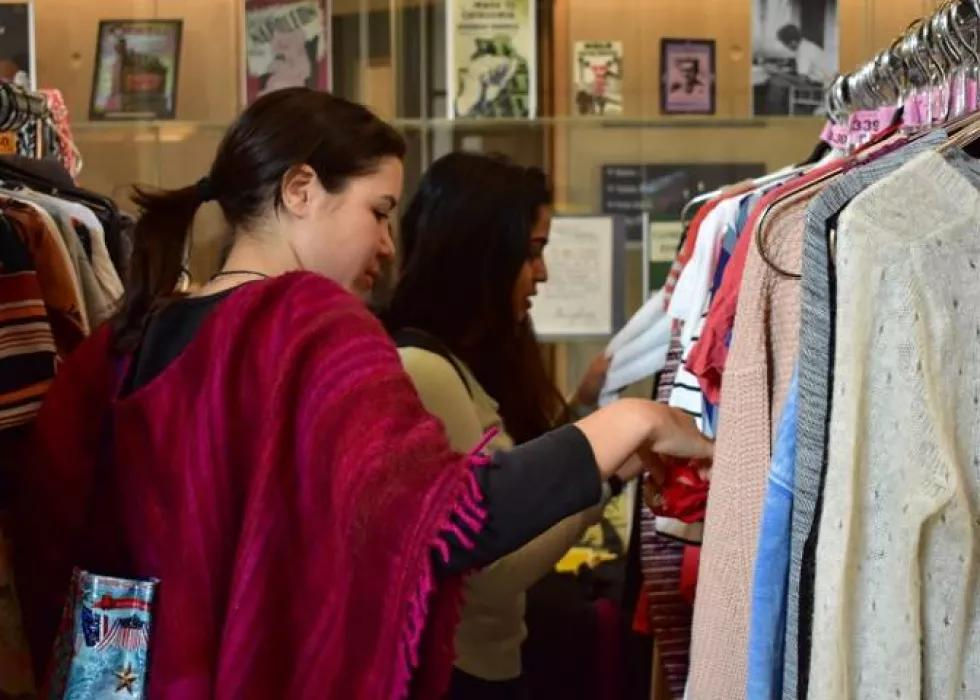
Clothes browsing image accompanying UCL’s clothes-swap volunteer notice.
Source: UCL, “Volunteer and help drive circular fashion at UCL”.
London: make reuse a service students can return to
UCL’s published 2026–27 programme lists six exchanges across the academic year, alternating between its Student Centre and the University of London’s Senate House. The next listed event is on 13 November 2026. Participants may bring up to eight suitable items, and a loyalty card allows those who find nothing to return at a later event. The programme also includes one-to-one mending support.[2]
These details matter. Repeat dates give students another opportunity if the available sizes or styles do not suit them. Quality checks can help make an exchange feel trustworthy. Bringing repair alongside redistribution addresses a separate problem: a garment may still be wanted but need attention before it can be worn again.
This is an established activity rather than a new launch. UCL’s Sustainability Annual Report 2023–24 records 1,212 students and staff exchanging 3,166 clothing items through its Clothes Swap events.[3] Those figures demonstrate participation and circulation; they do not, on their own, show how many purchases were avoided or how long the garments remained in use.
Singapore and Wuhan: begin where students already live and exchange
At NUS’s Pioneer House, Fashion Swap links clothing exchange to residential life. An NUS News report published on 6 February 2025 describes a student subcommittee organising the initiative and reports that approximately 50 kg of clothing changed hands at the October 2024 event. Residents exchanged used clothing for curated pre-loved pieces at no cost.[4]
The residential setting offers a useful design opportunity. Organisers can reach an existing community through familiar spaces and peer networks. It also makes practical work—collecting, sorting, displaying and storing garments—part of the learning experience. NUS’s report acknowledges logistical difficulties; a successful exchange depends on that labour as well as enthusiasm.
A mainland Chinese example shows a similar concern with how an exchange operates. Wuhan Textile University’s School of Fashion reported in May 2022 on a student-led “circular wardrobe” activity undertaken in 2021. The team organised publicity and registered garments with estimated values to support campus swapping.[5] The report provides a process description, but no quantified exchange totals. It therefore offers a useful model to examine, rather than evidence of a measured environmental saving.

Speakers at Wuhan Textile University’s May 2022 graduate forum, which included a presentation on the student-led circular wardrobe initiative.
Neither case should be treated as representative of an entire country. Their shared lesson is more specific: an exchange needs understandable rules and a community willing to maintain them.
Shanghai: bring the existing garment into design education
Donghua University provides a complementary route through teaching. A university report on a March 2023 presentation describes a sustainable fashion course undertaken with Theory. Students worked from more than 200 existing garments supplied by the company, using disassembly, analysis, reconstruction and adjustment to develop new designs. The report also records the establishment of a joint sustainable fashion teaching and practice base in 2021.[6]
This differs from a clothes swap: the learning task is to transform garments, rather than transfer them between wearers. For design students, an existing garment can become a source of information about construction, fit, material limitations and previous manufacturing decisions.
There is an important next step for such teaching. Alongside the final presentation, assessment could follow whether a redesigned piece is comfortable, repairable and worn afterwards. A striking runway result demonstrates creative achievement; continued use would provide a different kind of evidence about its circular value. Donghua’s report does not assess those later outcomes; they would be useful additions to future course evaluation.

A design presented in Donghua University’s sustainable fashion course with Theory, March 2023.
Compare the evidence, not just the headline numbers
These are different measures from different periods. They cannot support a ranking of the universities. Together, however, they show why reporting should distinguish materials received, garments actually redistributed, and items retained in use.
WRAP’s 2025 Displacement Rates Untangled provides another useful distinction. Research with participating businesses produced UK weighted average displacement rates of 82.2% for repair and 64.6% for resale: estimates of how often those activities replace a new purchase.[7] These are neither emissions-reduction percentages nor measured results for the campus projects above. Applying them automatically to a free student exchange would imply evidence that has not been collected.
Repair can teach a different relationship with clothing
UCL’s separately listed Repair Café on 13 November 2026 includes textiles support at the Institute of Making, UCL East. The event description offers help with patching, sewing and darning, with materials and tools provided. It brings together volunteers and expertise from several university departments.[8]
For fashion education, this suggests a way to reconnect making with care. A repair session can begin with an ordinary problem—a split seam or worn area—and turn it into a lesson in material behaviour and construction. Visible repair may also offer space to discuss craft and personal attachment, without assuming that every repair needs to become a decorative redesign.
What would make a campus programme last?
For SUSFUTURE’s university and design community, the next opportunity is to connect the strengths of these approaches: accessible exchanges, repair support and teaching that works with existing clothing.
A practical programme could publish recurring dates, clarify accepted garments, provide storage, and document where unclaimed items go. It could also preserve instructions and contacts between student committee handovers, so the work does not restart from zero each year.
Evaluation should continue beyond the event. A short follow-up after eight to twelve weeks could ask whether an exchanged or repaired item is still worn, whether it replaced an intended purchase, and whether a participant has used a newly learned skill. The published accounts do not yet answer these questions.
Universities have an opportunity to make that choice practical: a place to exchange, someone to learn from, and another date in the calendar. Circular fashion then becomes something students can practise in their daily lives—and critically evaluate through their education.
References
1. UCL. (2026, 19 October). Volunteer and help drive circular fashion at UCL. Source for the volunteer invitation, partnership and recurring programme.
2. UCL. (2026). Clothes Swap & Mending Station. Event listing for 13 November 2026 and the 2026–27 schedule. Source for exchange rules and mending provision.
3. UCL. (n.d.). UCL’s Sustainability Annual Report 2023–24 / Sustainable UCL Review 2024. “The Loop” highlights. Source for 1,212 students and staff and 3,166 exchanged clothing items. Reporting period, not publication date, is used in the article.
4. National University of Singapore. (2025, 6 February). Sustainability reimagined: NUS students get creative in building a more eco-conscious society. “Pioneer House” section. Source for the Fashion Swap and approximately 50 kg exchanged in October 2024.
5. Wuhan Textile University, School of Fashion. (2022, 27 May). 服装学院如期举办“衣·问”研究生论坛第六期——时尚可持续发展设计与实践(二) [Graduate forum on sustainable fashion design and practice, part II]. Source for the retrospective account of the 2021 circular wardrobe activity.
6. Donghua University. (2023, March). 我校中日合作项目部与国际时尚品牌合作可持续时尚设计课程 [Sustainable fashion design course with an international fashion brand]. Source for the March 2023 presentation, garment inputs and Theory partnership. Month/year follows the source URL; the text identifies the presentation date as 22 March.
7. WRAP. (2025, 27 February). Displacement Rates Untangled. Source for the UK weighted average displacement rates for repair and resale and their methodological context.
8. UCL. (2026). UCL Repair Café. Listing for 13 November 2026 at the Institute of Making, Marshgate. Source for repair activities, materials and cross-departmental participation. This is a separate event from the Senate House clothes swap on the same date.


Comments